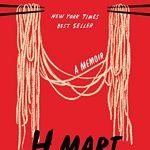
by Michelle Zauner, 2021
 Michelle Zauner has written a heartwarming story of love, loss, and food in her memoir Crying in H Mart, which came out in 2021. She is the only child of a Korean mother and an American father, and tells of her deep and abiding love of her mother whom she lost to cancer in her mid-50s.
The memoir is as much a love letter to her mother and how she raised her, as it is a love letter to the Korean culture and especially the Korean cuisine that her mother raised her on. We are treated to delightful anecdotes such as, “My mother didn’t actually teach me how to cook (Koreans tend to disavow measurements and supply only cryptic instructions along the lines of “add sesame oil until it tastes like Mom’s”).” [Side note: I laughed out loud when I read this—it was no different with a Polish mother. Trying to get a coherent recipe out of my mom for potato dumplings resulted in a sticky mess and I never tried again.] The book is chock full of recipes, menus, food smells, food textures, food visuals, and food traditions—indeed, food becomes a character itself in the book. Hardly a chapter goes by that you aren’t treated to something new in the way of breakfast, lunch, or dinner done the Korean way. It is truly a celebration of expressing your love for others through food.
“H Mart” is the giant supermarket that specializes in Asian food, far surpassing the token Asian aisle we see in American grocery stores. It’s where Michelle would go with her mother every week to get the endless variety of specialty noodles, vegetables, rice, kimchi, and other essentials for their pantry. Now that her mother was gone, what would she do when she forgot which brand of seaweed they used to buy? Hence the tears.
Michelle grew up in Eugene, Oregon, where she was the only Asian-American kid in school. She was continually scrutinized and asked not the “who are you?” question, but “what are you?” question—tormented by the cruelty of school-age kids who could not place her half-Korean features into a neat box. Even though I am whiter than White, I cringed when I read this, remembering all too well how awful young kids can be to the one who is different, and my heart went out to her.
On top of feeling like she did not belong at school, her mother placed exceedingly high expectations on her to excel in school. Also high expectations to stand straight, look nice, have perfect skin—she was a QVC shopping addict and ordered every cream and lotion that promised to preserve youth and beautify. She was hard on her in other areas. White people immediately raced to the doctor if their kids got hurt. If Michelle got hurt, “My mother would start screaming, not for me, but at me. I couldn’t understand it….my mom was livid, as if I had maliciously damaged her property.” I was told to “Stop crying! Save your tears for when your mother dies!”
While every teenager goes through their rebellious streak, being the sole object of your mother’s obsessions started to drive its wedge particularly early. Michelle describes herself as “rotting into a cruel teenager” with an eroding respect for her stay-at-home mother who seemingly had no ambition beyond keeping a home, raising a daughter, and placating a husband.
At about the age of 16, a half-Korean, half-white female musician caught Michelle’s attention—the first time she’d ever seen anyone who looked like her, doing something incredibly cool with a guitar, wild antics and wild lyrics on stage, and suddenly a world of possibilities opened up. How do I get to do that? She started badgering her mother for a guitar, and by Christmas of that year, scored a $100 Yamaha acoustic guitar from Costco. Guitar lessons, many gigs, and several years later, Michelle would be fronting for the indie rock group Japanese Breakfast; the story of how all this unfolded is one of the fascinating side tales of this memoir.
In the middle of her band’s tour, she would get a phone call that caused her to put everything on hold and return home for a few weeks’ hiatus. Her mother was diagnosed with terminal cancer at age 56. At the time, Michelle was 25 and living in the northeast, and made the decision to return to Eugene to see her mother through chemotherapy and help her father with anything they needed around the house. She didn’t theoretically know how to cook for the three of them, but was determined to learn on the job—using YouTube videos to get up to speed quickly so she could make her mother proud.
The stories of love, good food, self-sacrifice, a quickie wedding, and a final trip to Korea round out one of the best memoirs I’ve read in a long time. The author is brutally honest about her own shortcomings, which makes your heart break all the more for her losses.
[Disclosure: links to Audible.com/Amazon.com books, are affiliate links, meaning I’ll earn a small commission on qualifying purchases at no additional cost to you.]