by Philippa Gregory, 2024
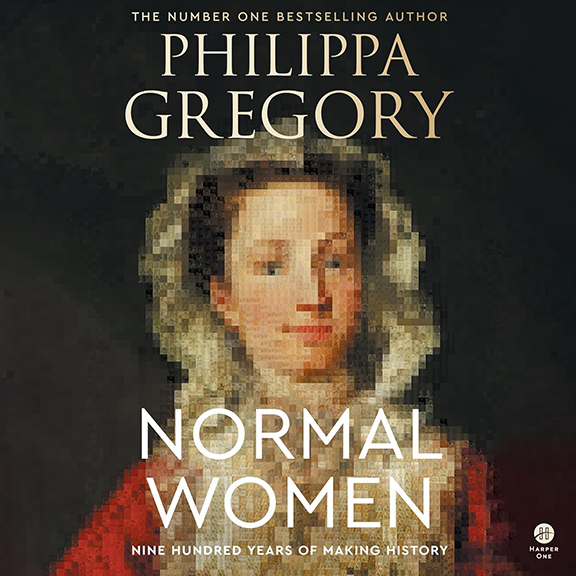 Normal Women: Nine Hundred Years of Making History—Unveiling the Untold Stories of Women Who Shaped England from 1066 to Modern Times is a history of women, yes, but specifically the history of women in Great Britain. One that we in the United States largely inherited in the form of attitudes, culture, and laws.
- The Bayeux Tapestry, which depicts the invasion of England by the Norman army in 1066, illustrates 632 men, 200 horses, 55 dogs, 500 other animals, and only five women. In fact, the tapestry has more penises on it than English women (93 to be exact).
- Women were strong, powerful, wealthy, and in charge until the Tudor period in England (1500s). We can thank King Henry VIII, who reversed this trend for good by his revolt against the Catholic church, closing all convents and monasteries and confiscating their wealth. Priests and monks could transfer into the Church of England, but there was no place for gifted, spiritual, well-educated women in the Church of England, or society, for the next 400 years.
- Charles Lyell, who was one of our founding fathers of geology, wrote our seminal textbook called Principles of Geology. I learned that his wife, Mary Horner Lyell, who was also a geologist, worked alongside her husband in the Canary Islands, was an expert on land snails, and could speak and write six languages. He is credited with her work.
- Charles Darwin, another pillar in my field of study, is quoted as saying, “Not only were women naturally inferior to men, but they would evolve to become even more inferior.” Ouch.
- In the 1800s, obtaining a higher education for a woman was a rare achievement. In 1836, Etheldred Benett was appointed a member of the Imperial Natural History Society of Moscow, a male-only institution so impressed by her collection of thousands of fossils and confused by her first name that they mistook her for a man and gave her an honorary doctorate.
Naturally, the examples I mention relate to my field of study: geology. But Gregory canvasses women’s contributions to the entire spectrum of professional life—medicine, law, politics, business, manufacturing, homesteading, art, academia, banking, farming, athletics, ship building, and construction of all types. Of course, there are also difficult chapters to read on childbearing, child-rearing, domestic violence, rape, and witchcraft. No book about the lives of women throughout history would be complete without those.
All women over the age of 21 were granted the right to vote in general elections as of 1929, 9 years after the ratification of the 19th Amendment in the United States in 1920. This came in baby steps, as it did here—first, in the late 1800s, the upper-class women who owned property in their own names were allowed to vote. This kept the poorer-class women (the majority) out of the voting booths so that they were no threat to the men. Eventually, Parliament was swamped by petitions from women’s suffrage societies, heavily represented by women working in the textile mills, and the laws were changed.
In this book, you will come across thousands of names and dates you’ll never remember. What will stay with you is that 50% of Britain’s population was oppressed, ignored, ridiculed, abused, and left out of the history books. And by extension, because we inherited their mindset, the same thing is true for the US.
No matter what your area of interest or your specialty, you will find your own heroine in these pages.
PS—The eBook and hard copy books are illustrated and heavily footnoted.