by Patrick Radden Keefe, 2026
There are certain authors who publish books periodically, and I will read virtually anything they write. One such author is Patrick Radden Keefe, whose investigative journalism is nearly unmatched. He has written six books; among them Empire of Pain (the secret history of the powerful Sackler family, their founding of Purdue Pharma, and their role in the opioid epidemic), and Say Nothing (true story of the abduction and murder of a 38-year-old widow during the Troubles in Northern Ireland). When I learned that he had another book coming out in 2026, I put it on preorder.
[Links to Amazon are affiliate links, meaning I earn a small commission at no additional cost to you.]
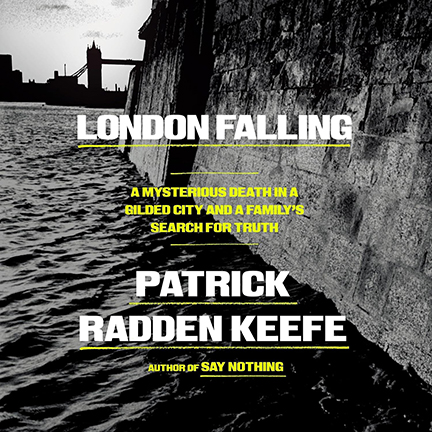 The story of Zac Brettler’s plunge into the Thames and death by apparent suicide, and the mysterious circumstances preceding his death, was first published as an essay in The New Yorker in February 2024: A Teen’s Fatal Plunge into the London Underworld, by staff writer Patrick Radden Keefe. It has now become a 2026 bestseller: London Falling: A Mysterious Death in a Gilded City and a Family’s Search for Truth.
As I got into this book, it reconfirmed my belief that truth is always stranger than fiction. Because the shockwaves he delivers as I listened to the audiobook absolutely blew my mind.
In the early morning hours of November 29, 2019, 19-year-old Zac Brettler jumped from a fifth-floor balcony of a luxury apartment to his death in the Thames River. A security camera operating across the river from the building captured Zac’s fall—it was the camera of MI6, the British spy agency.
As Zac’s grieving parents try to work with Scotland Yard to investigate his apparent suicide, they met with the friends who were the last people to see their son alive, Akbar Shamji and Verinder Sharma. Only Akbar and Verinder are shocked to find out who Zac’s parents are—and who they aren’t.
Zac had told them that his father has passed away, his mother lives in Dubai, and he was the son of a Russian oligarch. They believed Zac’s last name was Ismailov, and he was set to inherit a vast fortune as soon as the “disposition of his father’s multibillion-dollar estate was completed.”
Both men were quite interested in this vast fortune. Unbeknownst to Zac, Akbar was a charlatan who had just declared bankruptcy, and Verinder was an aging gangster who was thinking about retirement, and on the lookout for a final score. Both realized at some point that they had been resoundingly lied to by Zac—but Zac wasn’t the only one lying.
This 19-year-old had created a complete alter-ego for himself and in doing so, got himself tangled up in London’s gangster underworld.
Zac’s real parents, Matthew and Rachelle Brettler, understandably reeled from this revelation. Matthew was in banking and “made a comfortable living”; Rachelle never went to university and worked off and on as a freelance journalist. One thing they had in common was that both their fathers had survived the Holocaust; they were both down-to-earth and eschewed flashy lifestyles and material possessions. They lived in a 2,000-square-foot home and couldn’t imagine needing more than that.
Looking back, his parents pinpointed Zac’s enrollment at a certain private school as the time when he started to change, transitioning from a happy, funny 13-year-old kid to one consumed by money and status.
Zac’s older brother Joe was accepted into University College School, a selective private school that placed a strong emphasis on academics. But when it came time for Zac to apply, he failed the admissions tests twice and was rejected. He was later accepted into Mill Hill, a different private school in northern London. The students at Mill Hill came from a different class of the London population—they had much more money, and this was new money. Many of the international students were children of oligarchs—obscenely wealthy, entitled ex-Soviets. “On cold winter mornings, some of the boarding students, rather than make the eight-minute walk from the dormitory to class, would summon Ubers.”
Zac was fascinated by these wealthy students, not only their riches, but their swagger and how they showed off their wealth. He quickly fashioned a new identity for himself in this new school where no one knew his background: he turned into “a brilliant but unmotivated class clown who became obsessed with money.” He wanted what they had and decided he would do most anything to get it.
It was an easy steppingstone for Zac to go from admiring these students and their lifestyle, to pretending he was one. He eventually went into business with some of the most dangerous of London’s underworld, including Akbar and Verinder. That a teenager could so completely fool these hardened criminals who were decades older than him is almost beyond belief.
The author does a masterful job of researching the seedy side of London, the corruption and ineptitude of Scotland Yard, and the shady business dealings that may have led to Zac’s demise.
London Falling is a must-read if you love true and astonishing stories. On Amazon, one reviewer of Keefe’s books has said, “If Keefe wrote a book on how grass grows, I would read that book.” I have to agree.